
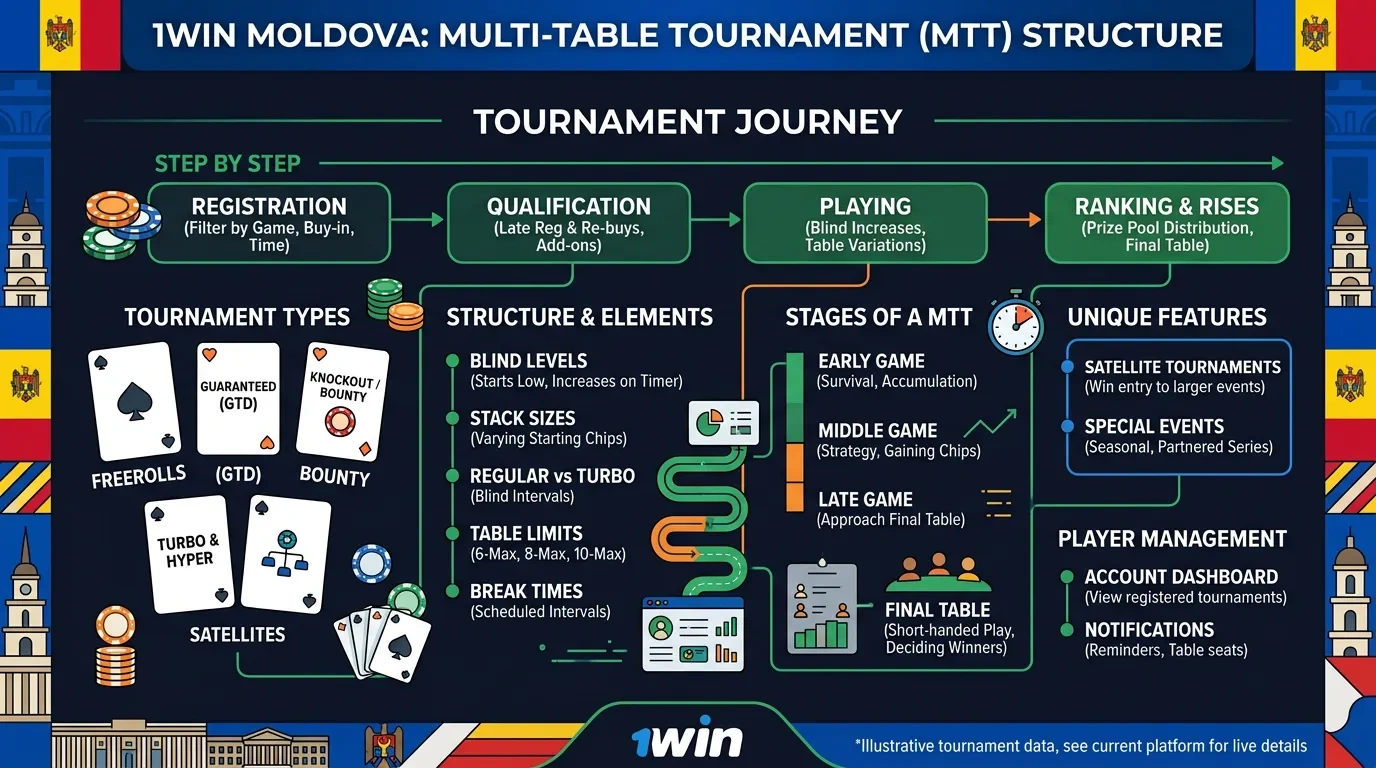
Multi-table tournaments collect players across tables. Each player at https: //1win-bet.md/ pays a buy-in. They get a chip stack. The fees make up the prize pool. Players who finish at the top get payouts based on rank. The 1win poker room eliminates players round by round. This process continues until only one champion remains.
How does tournament registration work?
The tournament lobby lists every event that will start soon. Players can read event details before they pay. Find entry requirements and event times directly on the page.
- The event schedule displays all tournaments. No events are left out;
- Each tournament lists the buy-in and the fee as separate numbers. This makes the cost clear;
- Registration starts hours before each tournament;
- Late registration stays open through the first levels. Players can join during this period;
- When a player registers, the system assigns that player a seat. No one can choose seats;
- Only one account can use each seat;
- Players may unregister before the event starts. This option closes when play begins;
- The lobby explanation covers rules for re-entering an event. All re-entry information appears in the description;
- Pay with a ticket or use your account balance. Both payment options are available.
Buy-in tiers and costs
Buy-in amounts go directly into the prize pool during Multi-Table Tournament Structure at 1Win Moldova events. Each entry uses two charges.
- The buy-in amount goes into the prize pool;
- A house fee covers all operator costs. This fee does not add to the prize pool;
- The tournament structure uses a fee format. Players see both the buy-in and the fee before they register;
- Tournaments on the schedule list fields that span different stake levels;
- Lower buy-in events have fields. Entry amounts set the number of participants;
- Satellites let players get entry into events. Winners secure a seat for a cost than the main event buy-in;
- Re-entry allows players to try again. Each new entry puts more money into the pool;
- Prize pools are displayed before registration opens. Players see awards before they join;
- Fees remain fixed, even if the number of entries changes. Each player pays the amount.
What blind schedules apply?
The Multi-Table Tournament Structure at 1Win Moldova uses blind progression logic. Each participant gets the number of chips at the start of the tournament.
- Every player begins with a chip count, even if joining after play has started;
- Stack depth is measured in blinds. This lets players see how much pressure they face at the table;
- Events begin with stacks. These usually have a value between 20 and 40 blinds;
- Some events begin with 100 or more blinds;
- Blinds increase at intervals as the event runs;
- Online formats often set blinds to rise every minutes;
- Events use levels. Each level may last for 15 minutes. Some last for 20 minutes;
- Antes come later in the tournament. These add size to pot;
- The display shows information about the next blind level;
- The structure sheet lists blind level before players can register.
Table balancing mechanics
Initial seating uses random assignment when the Multi-Table Tournament Structure begins at 1 Win. This method is fair. No player gets an edge at the start. As the tournament continues, some players leave. The system then adjusts seat distribution. This adjustment happens in real time, which keeps play balanced.
- At the start, the system gives each player a seat. It uses no bias;
- The system places players at several tables. Table count depends on the number of participants;
- When players get eliminated, seats become empty at various tables;
- The system tracks these changes. It moves players to keep groups even. Balance is the goal;
- Table sizes remain close to equal. No table has more or fewer players than the others for any period;
- Redistribution follows a rule. The system puts players at the tables with the lowest headcount first;
- If a player re-enters, the system assigns a seat. No manual choice is involved;
- The sequence for closing tables is fixed. The system follows a list;
- At the event’s end, all remaining players move to one table. The match ends at that table with the final play.
Can players re-enter tournaments?
Multi-Table Tournament Structure at 1Win Moldova uses several formats. Players can return to the tournament after elimination, but only during stages set in advance.
- In some events, players can re-enter;
- The rebuy period covers levels of play;
- If a player loses every chip, that player can buy another stack;
- The rebuy gives a stack that matches the buy-in;
- An add-on is available during the break;
- A player may take one add-on. The add-on increases the chip stack a time;
- The rebuy cost matches the buy-in;
- To re-enter, a player must take a seat at the table;
- The tournament lobby has the rules;
- Some tournaments use the format.
What prize payout structures exist?
The total prize pool is the amount from all buy-ins, with the operator’s fee removed.
- Pool equals buy-ins sum – every entry fee contributes directly to total reward fund;
- Field size defines paid places – larger tournaments distribute money across more finishing spots;
- Around ten to twenty percent paid – most events reward roughly 15 percent of registered entries;
- Top three earn most – podium finishes claim majority of available pool;
- First place largest share – winner collects approximately 30 percent of distributed money;
- Payout ladder shown in lobby – complete breakdown appears before registration closes;
- Bubble is last unpaid position – final elimination before money starts creates tension;
- Deal making may split prize – remaining players can negotiate alternative distribution at final table; Deal formula uses chip counts – Independent Chip Model calculations determine fair splits;
- Minimum cash often doubles buy-in – smallest payout typically returns twice entry cost;
- Minimum cash often doubles buy-in – smallest payout typically returns twice entry cost.
Tournament stage progression
Tournaments run through three distinct phases. The Multi-Table Tournament Structure at 1Win Moldova uses this sequence for every event.
- Deep stacks dominate early phase when players hold 100 to 200 big blinds and can see many flops;
- Average stacks drop during middle phase as eliminations thin the field and antes appear;
- Blind pressure increases steadily through all levels and forces more aggressive decisions;
- Short stacks shove more often when chips fall below 15 big blinds;
- Late phase near bubble creates maximum tension as payouts approach;
- Stack size gap widens late between chip leaders and desperate players;
- Level length unchanged across phases maintains consistent time intervals;
- Antes raise pot sizes later and add extra chips to every hand;
- Each phase affects strategy from tight early play to aggressive late moves;
- Structure speed shapes phases by setting how fast blinds climb relative to starting chips.
What happens at bubble stage?
The bubble stage begins when only one player needs to be eliminated before the remaining field reaches the payout positions. Pressure and tension often rise in this phase because every decision can mean the difference between leaving empty-handed or securing a prize.
- Bubble appears before payouts;
- One bust moves field into money;
- Short stacks face high risk;
- Big stacks pressure medium stacks;
- Payout jump list shows steps;
- Hand-for-hand mode can run; Hand-for-hand synchronizes action;
- Bubble burst time varies; Deeper structures lengthen bubble;
- After bubble busts accelerate;
- Deeper structures lengthen bubble;
- After bubble busts accelerate.
Tournament schedule organization
Daily schedules list all events with start times and formats. Multi-Table Tournament Structure at 1Win Moldova runs tournaments across every hour with different stakes and speeds.
- Operator lists daily MTT schedule with complete timing information;
- Peak hours show higher buy-ins attracting stronger competition;
- Off-peak times run smaller fields with reduced entries;
- Weekly majors feature larger guarantees on Sundays;
- Some events repeat every hour throughout the day;
- Satellites precede major finals by several hours;
- Turbo events cluster around evenings when players prefer faster action;
- Deepstack events placed in off-days for longer sessions;
- Series festivals add temporary events during special periods.
What are MTT formats?
Texas Hold’em is central in most poker room schedules.
- Texas Hold’em forms bulk schedule with daily events at multiple buy-in levels;
- Omaha events appear in rotation adding pot-limit variants to weekly calendars;
- Freezeout events block rebuys requiring single-entry commitment from participants;
- Rebuy tournaments allow many restacks during early blind levels until break;
- Turbo events use short levels lasting three to five minutes each;
- Hyper formats compress levels further pushing action with two-minute blinds;
- Progressive knockout events share bounties placing cash prizes on each elimination;
- Satellites feed larger target events offering discounted paths to major buy-ins;
- Some events use shootout format keeping tables intact until single winner emerges;
- MTTs sit alongside Sit and Go giving players choice between scheduled and on-demand action.